The King’s Speech 2026: what it means for landlords and tenants in South West London
May 15th, 2026
May 15th, 2026
When people talk about the King’s Speech, they often mix it up with the ‘King’s Christmas Address’… or with the film starring Colin Firth.
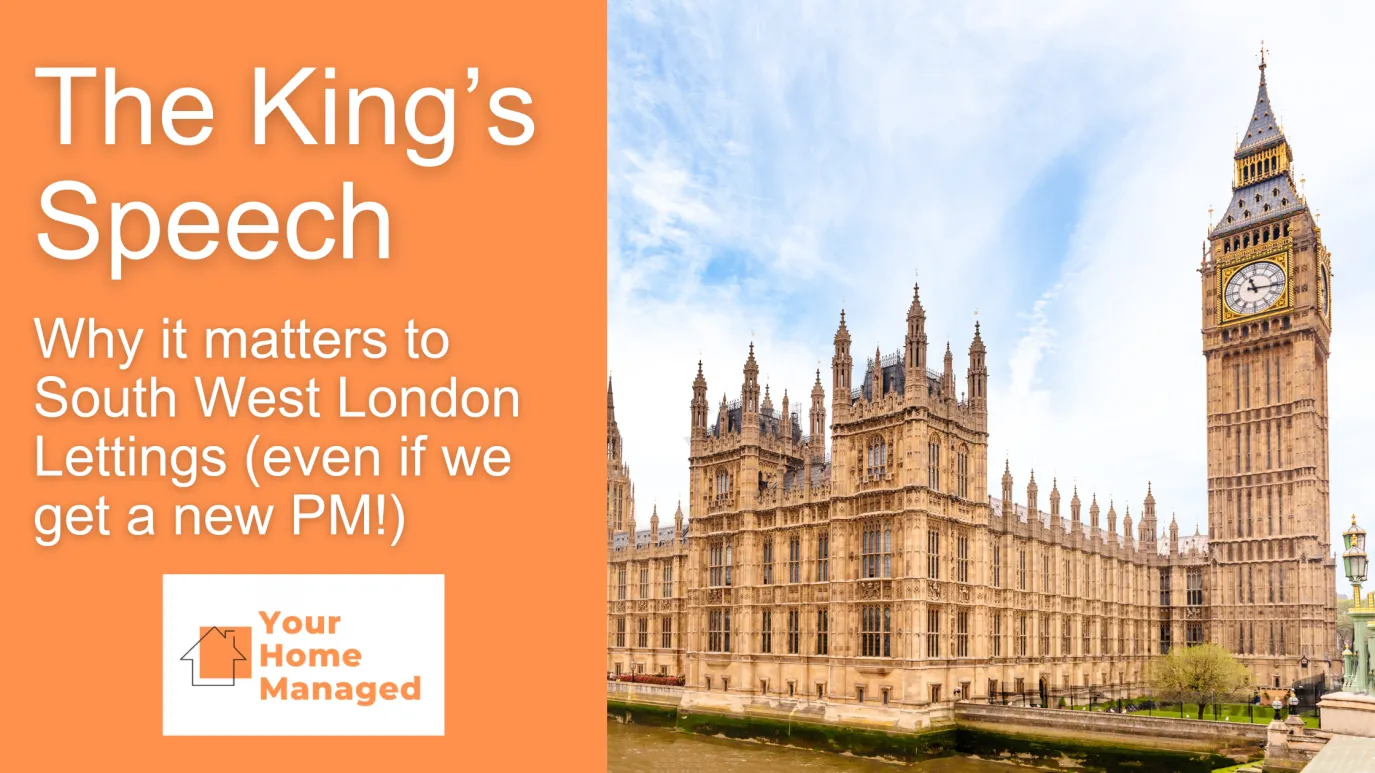
But we have just had the actual King’s Speech, on Wednesday 13 May. The parliamentary kind.
And if you’re a landlord, a seller, or even just considering your next move here in Tavistock, it matters more than you might think.
Every year, at the start of a new parliamentary session, the King reads a speech to the House of Lords. It’s written entirely by the government of the day – the monarch’s words, but Downing Street’s agenda. Think of it as the government’s official to-do list, but dressed in ermine and delivered from a gilded throne.
The bills named in the speech are those the government is formally committing to introduce. Unlike a manifesto promise or a ministerial interview, this is as close to a legislative guarantee as politics gets.
There is, of course, the small matter of a possible Labour leadership contest – to illustrate just how quickly things are moving, when I sat down to write this piece, Wes Streeting was still Health Secretary. By the time I reached paragraph six, he had resigned. Nevertheless, as I’ll explain below, a change of leader would not derail what’s already been set in motion. But more on that in a moment.
Much of this year’s speech focused on security and broader economic issues. But two pieces of housing legislation were named that will have a direct bearing on landlords and tenants – and given that 58% of properties in South West London are leasehold, they matter here more than almost anywhere else in the country.
The first piece of legislation named in the speech we think is worth highlighting to landlords in South West London in particular is the Social Housing Renewal Bill, which commits the government to increasing long-term investment in social housing.
This matters to the lettings market in ways that aren’t always obvious. Currently, 21% of residents in South West London live in social rented housing, reflecting both the diversity of the area and the chronic undersupply of affordable homes. That shortfall doesn’t disappear simply because social housing isn’t available – it gets displaced into the private rented sector, driving up demand, pushing up rents, and placing real strain on tenants who might otherwise never have needed to rent privately.
The private rented sector has, for too long, been asked to do the government’s job for it. Landlords are not social housing providers – and the distortions caused by treating them as such have benefited nobody.
If this bill genuinely delivers more social housing over time, it will gradually ease that pressure: rents may moderate, competition for available properties may ease. For tenants, that’s straightforwardly good news. For landlords, a healthier, more stable market ultimately serves everyone better than an overheated one.
The second piece of legislation announce, and potentially a big one for the lettings market, is the Commonhold and Leasehold Reform Bill.
King Charles announced:
“My Ministers will bring forward legislation to […] reform the leasehold system, including the capping of ground rents.”
For landlords who own leasehold flats – which, in South West London, means a very large number of you, with 58% of properties in this area being leasehold – this has real and immediate implications.
Ground rent reform has been promised for years. This bill signals a firmer push towards making that happen – specifically towards capping ground rents at £250.
Many leasehold properties, particularly those sold in the 1990s through to the 2010s, carry clauses that see ground rent double periodically; often every twenty-five years.
These have become a serious problem: mortgage lenders increasingly refuse to lend against them, making the properties hard to sell and harder to refinance. For landlords sitting on buy-to-let flats with onerous ground rent terms, this legislation could be genuinely liberating. If that sounds like you, it is worth speaking to a solicitor now for advice; you do not need to wait for the bill to pass, and you could discuss the option of a deed of variation if you are struggling to remortgage or sell the property.
Of course, if the problem is to be removed with the proposed ground rent cap, perhaps that changes your view of the market and its benefits to you, insofar as remaining in it as an investor and stakeholder.
The bill also pushes forward the concept of commonhold – a form of flat ownership where you own your unit outright and share ownership of the building with your neighbours, rather than holding a lease from a landlord. It eliminates ground rent entirely and gives residents collective control of their building.
Commonhold has technically existed in England and Wales since 2002, but was so poorly designed that fewer than 20 developments across the country ever adopted it. This bill aims to finally make it workable – and, over time, the default way to own a flat.
For the lettings market, this matters more than it might first appear. Leasehold properties with dwindling lease lengths or escalating ground rents have created a trap: landlords who want to sell can’t, because buyers can’t get mortgages. Many have stayed in the lettings market not by choice, but because they had no viable exit. Leasehold reform gives them one – and that is a meaningful change for the South West London rental sector.
It might enable a few more landlords to sell their property, if that has been an obstacle. It may also encourage more to invest in the sector.
This has been a question I have seen asked a couple of times this week.
The answer is, almost certainly, ‘yes’.
The King’s Speech belongs to the government, not the Prime Minister personally. A new leader inherits the parliamentary mandate – the MPs, the majority, and the manifesto commitments. Scrapping popular legislation like leasehold reform, which resonates with millions of flat owners, would be politically costly for any successor.
There were reversals to policy made when Rishi Sunak became Prime Minister, replacing Liz Truss, but the same comparison doesn’t apply. Those reversals followed an economic crisis of the government’s own making.
Leasehold reform and social housing investment are not in that category.
If you own a leasehold property – particularly one with a short lease or a ground rent that has doubled – it would be worthwhile getting advice now, not when the bill becomes law.
Preparation takes time, and landlords who are ready will be in the strongest position when reform lands – particularly if you own a leasehold property in a block and wish to think about switching to commonhold when the moment arrives; you will need 50% support from other leaseholders in the building.
If you’re a tenant, the direction of travel is broadly in your favour: more social housing supply and a private rented sector that, over time, should face less artificial pressure. In other words, rents that don’t keep escalating out of reach, due to excessive demand on the sector.
And for everyone in the South West London market, the wider economic signals matter too. A government committed to stability and falling inflation is signalling predictability to the mortgage markets. That’s important, and something we would all welcome.
If you want to talk through what any of this means for your property or tenancy, please give us a call or drop us a message. We are always happy to talk.
We use cookies to give you the best possible experience on our site.
For more information click here.